Wednesday, 18 June 2014

Big Seas


‘At the third gust the wind became so strong that it shattered our lateen yard down the middle, and snapped the Julia’s main mast. Great packets of sea rolled over us – it was stupefying to see.’ 
I’ve been writing about Vasco da Gama’s voyages to India – small ships lurching and rolling in the enormous seas south of the Cape of Good Hope; the Portuguese shipwreck statistics along the African coast and the total disappearance of vessels swallowed up by the ocean were alarming.

To get some further imaginative sense of what it would be like to confront the ferocity of really big seas in a sailing boat I picked up The Last Grain Race by Eric Newby. Newby, out for adventure as a nineteen year old, signed up as a sailor on the Moshulu, one of the last sailing ships to carry grain from Australia, just before the Second World War.

Here’s Newby’s account of heading for Cape Horn in the heaviest seas in the world:

 “The barometer fell and fell, 746, 742, 737 millimetres. The sun went down astern, shedding a pale watery yellow light on the undersides of the deep black clouds hurrying above the ship. It was extremely cold, colder than it had ever been, blowing a strong gale, force 9. Big seas were coming aboard. I felt very lonely. The ship that had seemed huge and powerful was nothing now, a speck in the Great Southern Ocean, two thousand miles eastwards of New Zealand, three thousand from the coast of South America…to the south there was nothing but the Antarctic ice and darkness. She was running before seas that were being generated in the greatest expanse of open ocean, of a power and size unparalleled because there was no impediment to them as they drove eastwards round the world. She was made pigmy too by the wind, the wind that was already indescribable.

At this moment, for the first time I felt certain of the existence of an infinitely powerful and at the same time merciful god. Nearly everyone in the ship felt something of this, no one spoke of it. We were all of us awed by what we saw and heard beyond the common experience of men.”


The Portuguese have a proverb – if you want to learn to pray, go to sea.

Strangely the Moshulu still exists – she’s a floating restaurant in Philadelphia.

Wednesday, 21 May 2014

Nicholas Winton's holiday


Few people could have put a holiday to better use than Nicholas Winton – I’ve been reading about him today. Winton, a 29 year old London stockbroker of Jewish origin, was about to go skiing in December 1938 when he received a phone call from a friend  in Prague asking him to go and help Jewish refugees living in terrible conditions in camps. He went. He was appalled. He did something. In three weeks there he planned the mass evacuation of Jewish children, organized the paperwork and set about finding host families and money to bring them to Britain, and bullied British officialdom to act.


During the first half of 1939 Winton’s kindertransport managed to bring 669 children in eight trains to host families in Britain. The ninth, scheduled for 1 September 1939, never arrived. War had broken out. The children waiting eagerly at the Prague station were spirited away. He remains haunted by the memory: "Within hours of the announcement, the train disappeared. None of the 250 children aboard was seen again. We had 250 families waiting at Liverpool Street that day in vain. If the train had been a day earlier, it would have come through. Not a single one of those children was heard of again, which is an awful feeling."

Winton with one of the evacuees


And Winton went back to ordinary life and never talked about what he had done – not even to his wife. It would be fifty years before she stumbled on a scrapbook in the loft and the whole story came out. Since then it has been widely publicised and the children of this evacuation have been coming forward – as ‘Winton’s children’.


Here’s a snippet from a TV programme about a reunion with the now elderly children and their descendents. It’s a real tearjerker. Winton is still alive. He’s just been awarded the Czech Republic’s highest honour. He’s 105.


Winton with the children

Sunday, 11 May 2014

The Chapel of Bones

My Chinese publisher recently sent me this ghoulish picture of one of Malta's top nineteenth century tourist attractions: the Chapel of Bones in Valletta, reputed to be decorated with the neatly organised remains of those who died in the siege of Malta in 1565 - skulls round the arch and lined up in gawping rows beside the entrance, arm bones crossed like images from a pirate flag. The overall arrangement is quite a work of art. I didn't know about this when I was writing Empires of the Sea  - and was grimly fascinated. But as the chapel was said to contain the remains of 33, 000 people it must have been an ossuary drawing on the remains of Maltese people over a much longer period.


It was destroyed by a Luftwaffe bomb in the Second World War and is reputed to lie somewhere underground - waiting to be resurrected.

Otranto, on the heel of Italy, has a similar monument to the dead in the Ottoman-Christian wars. The Cathedral of Bones embeds the remains of 800 defenders executed after the shock Ottoman invasion of 1480. What times...


Thursday, 3 April 2014

A good man in Rwanda

Spare a few minutes for this moving report on Capt Mbaye Diagne, UN peacekeeper in Rwanda, described by the BBC's Mark Doyle as the 'the bravest man I ever met'.

Tuesday, 1 April 2014

‘Thanne longen folk to goon on pilgrimages’


The first of April. Here in Gloucestershire soft sunlight and birdsong. Nothing summons up for me this sense of early spring so beautifully as the start of Chaucer’s Canterbury Tales – eighteen lines, one seamless sentence – that links humans to the stirring of the natural world. Written at the end of the Fourteenth Century the opening of the prologue catches this moment of the year – the tender crops and the young sun, the singing of birds and the inevitable awakening in people to be out there, to see the world, to travel. If we feel this in our modern centrally heated houses, how much more powerful must it have been for medieval people, sewn into their clothes all winter, eating whatever starveling rations they could get, trying to keep warm – and then the astonishment of new life, the vivid colours of flowers, the softer breeze and the sun on their faces – and the more material comfort of food crops growing again.

‘Whan that Aprill with his shoures soote

The droghte of March hath perced to the roote,

And bathed every veyne in swich licour

Of which vertu engendred is the flour;

Whan Zephyrus eek with his sweet breeth

Inspired hath in every holt and heeth

The tender croppes, and the yonge sonne

Hath in the Ram his halve cours yronne,

And smale foweles maken melodye,

That slepen al the nyght with open ye

(So priken hem nature in hir corages):

Thanne longen folk to goon on pilgrimages,

And palmeres for to seken straunge strondes,

To ferne halwes, kowthe in sondry londes,

And specially from every shires ende,

Of Engelond to Caunterbury they wende,

The hooly blissful martir for to seke,

That hem hath holpen whan that they were seeke.’

 Pilgrimage was both a powerful spiritual surge, as it still is today, but it was also travel, adventure, the chance ‘to seken straunge strondes  and sondry londes’ – of course with its attendant risks: the pilgrims in Chaucer’s tales ride together for mutual security. Some of the Christian pilgrim narratives of the middle ages, particularly those to the Holy Land, stand as the first European travel literature.

I really like the sound of Middle English; it has an authentic music. You can hear this passage – the opening of the prologue – read here, with some variation in text and spelling.


Thursday, 20 March 2014

'Life is an inn'


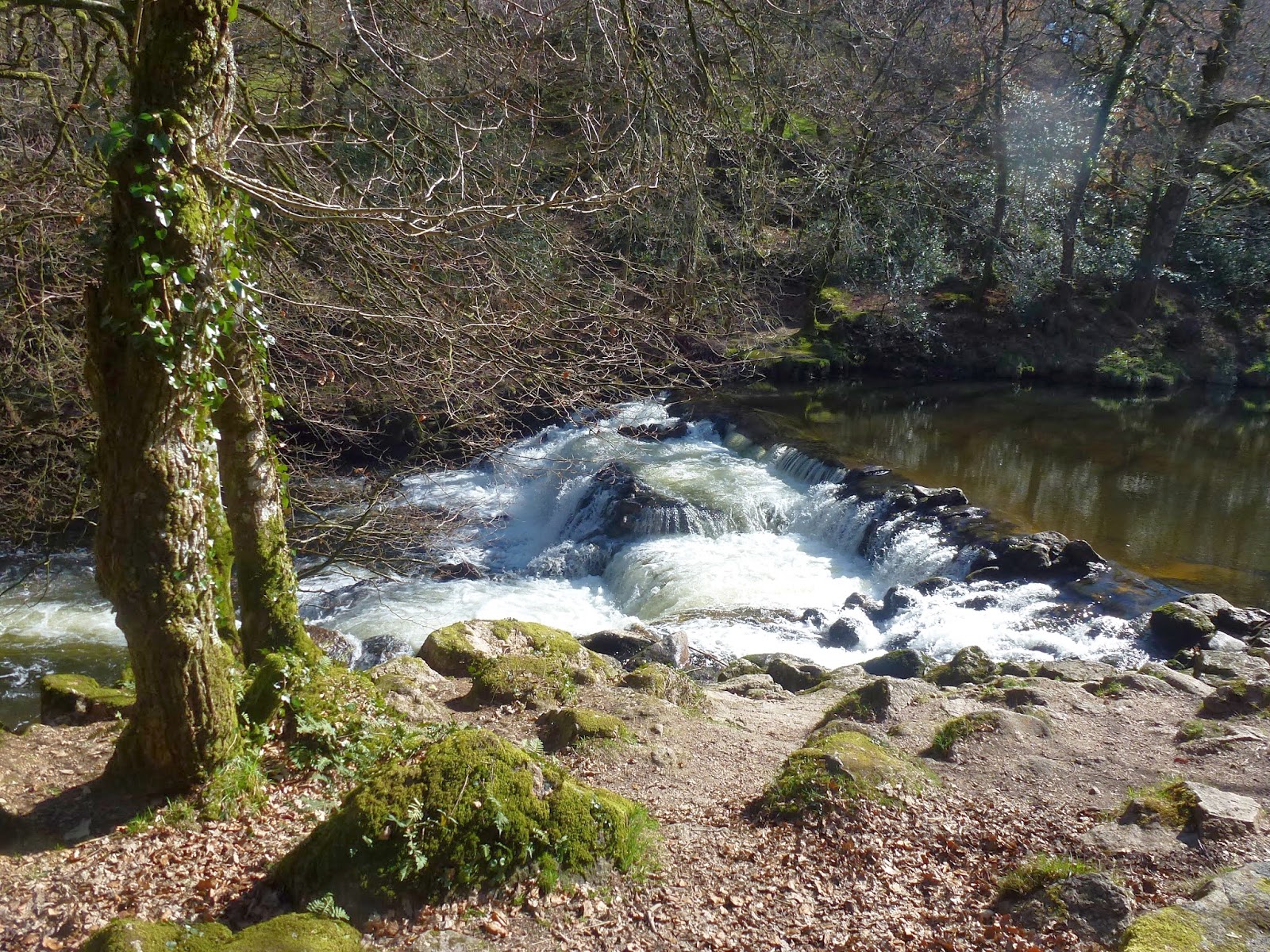
I have been to Dartmoor for the weekend in the spring sunshine. It can’t be said that the southern half of England has any sense of wilderness by North American standards, but Dartmoor is as good as it gets – a bleak, eroded, atmospheric plateau of moorland and granite tors, once covered with trees, and peppered with prehistoric standing stones and hut circles, moss covered boulders, craggy, gnarled trees bent by the wind, bogs and fast flowing streams.


Under a light blue sky it’s cheery and bright. In the mist – think of the terrifying howl of the Hound of the Baskervilles. It comes with its own legends. Whilst camping here years ago with a handy little guide to the ghosts of Dartmoor as my sleeping bag side reading I was particularly appalled by the Story of the Hairy Hands, which would clutch the shoulders of petrified motorists driving the long lonely roads at night and wrest the steering wheel into a death crash. It’s easy to see how Conan Doyle got inspired…


And I visited a lovely Cornish church – St Swithins at Luancells outside Bude – a typical granite church, with its own holy well (good for eye complaints), set above a small stream, among trees animated by cawing, nest-building rooks, daffodils and celandines and the first bees.


It’s perfect. Ancient tombstones carrying the names of long generations of the same families – before people got restless and lost the sense of place; ancient wooden pews, gnawed by time; the local gentry reclining in leisurely fashion in their comfortable wall monuments; a list of vicars reaching back 700 years – men who sound like characters from Arthurian legend: Sir John de Launcelas, Sir Philip de Romelode, Sir Baldwin Tybot (they were a titled lot in the Middle Ages) – and the splendidly named Sir Walter Cola; fifteen century floor tiles and cheery epitaphs on memorial slabs, such as this:


Life is an inn; think man this truth upon;
Some only to breakfast and are quickly gone;
Others to dinner stay and are full fed;
The oldest man sups and goes to bed.
Large is his debt who lingers out his day;
Who goes the soonest has the least to pay.


I think the light-hearted message here (apart from living being a form of gluttony) is that the sooner you die, the fewer sins you have to work off. Phew.


Wednesday, 12 March 2014

The Way of the World

In between writing, I'm reading The Way of the World by Nicolas Bouvier, a book I've been putting off for years, in the perverse belief that it would prove too enjoyable. Which it does.

It's the tale of a road trip taken by two young Swiss, Bouvier and his friend Thierry Vernet, from Serbia to Afghanistan around 1953-54. They travel in a small underpowered tin Fiat at about 15 mph - so slowly they have time to see everything, record the world around them. They have an accordion and a guitar and they play music with the gypsies; they paint and write and see the world afresh, as if for the first time.

Here's Bouvet, snowed into Tabriz in Iran for six months, on the subject of bread:

"At daybreak the smell of the ovens drifted across the snow to delight our noses; the smell of the round, red-hot Armenian loaves with sesame seeds; the heady smell of sanjak bread; the smell of lavash bread in fine wafers dotted with scorch marks. Only a really old country rises to luxury in such ordinary things; you feel thirty generations and several dynasties lined up behind such bread. With bread, tea, onions, ewe’s cheese, a handful of Iranian cigarettes and the leisurely pace of winter, we were set for a good life."

And here on the Turkish plateau at night on the edge of autumn, the memory of one of those special moments that travel brings:

“East of Erzurum the road is very lonely. Vast distances separate the villages. For one reason or another we occasionally stop the car, and spend the rest of the night outdoors. Warm in big felt jackets and fur hats with ear-flaps, we listened to the water as it boiled on a primus in the lee of the wheel. Leaning against a mound, we gazed at the stars, the ground undulating towards the Caucasus, the phosphorescent eyes of the foxes.

Time passes in brewing tea, the odd remark, cigarettes, the dawn came up. The widening light caught the plumage of quails and partridges...and quickly I dropped this wonderful moment to the bottom of my memory, like a sheet anchor that one day I could draw up again. You stretch, pace to and fro feeling weightless, and the word ‘happiness’ seems too thin and limited to describe what happened.

In the end the bedrock of existence is not made up by the family or work or what others say or think about you, but of moments like this when you are exalted by a transcendent power that is more serene than love. Life dispenses them parsimoniously; our feeble hearts could not stand more.”

When I get to the end I’ll probably start again.
 
The cover of 'The Way of the World', by Nicolas Bouvier
Nicolas Bouvier on the road in Turkey