Friday, 26 July 2013

A face in the dark


It’s been uniquely hot in England over the last few weeks – we wait a decade for a spell of good weather like this then I find myself spending much of my days in a cool darkish room in our three hundred year old stone cottage, writing. My companion on the desk has been this picture. It’s an image on a book mark for a book that I bought – hence the names of the authors visible on the section I’ve reproduced. I didn’t particularly choose to have it there but the desk tends to accumulate objects that take up residence – until it all gets too crowded and I shoo them off, but I like this face, and it’s survived the recent clearing back.

 
It’s a portrait of Vasco da Gama, painted at the very end of his life. I’ve seen the original in a museum in Lisbon, which is surprisingly small. It’s an exquisite image. The face glows against the dark background; a gentle, almost serene expression, the beard caught by a soft radiance. The gold cross gleaming out of the blackness is that of the Order of Christ, Portugal’s crusading order, the successor to the Templars who uniquely escaped persecution in the country by a crafty piece of rebranding just as they were being wiped out.


It seems to me the face of a man who has lived his life and come to terms with everything. The cross is evidently there as an emblem of his faith and deeds as a crusader for Christ. I have to say the meekness of the face rather clashes with the known facts. Da Gama enjoys a terrible reputation as the conquistador of the Indian Ocean, guilty of some awful atrocities, possessed of a violent temper and not in the least tranquil. Maybe in old age serenity came upon him; maybe he was flattered in the painting. Whatever, he gazes calmly up at me. The days are hot. Outside the bees rummage the flowers. I write on.

Wednesday, 17 July 2013

Voices from Cairo

As Cairo becomes a turbulent battleground for the soul of modern Egypt I have found myself reading about its equally turbulent, exotic and frankly weird past.


I’ve been trying to skip read a chronicle covering the years roughly 1500- 1515 to discover how the sultan in Cairo reacted to the aggressive arrival of the Portuguese in the Indian Ocean. The trouble is that the detailed accounts of daily life in the city are so fascinating that I keep getting distracted. It’s an extraordinary Arabian Nights world – violent, fantastical, prone to bouts of superstition and magic, obsessed with rituals, exotic pageantry and terrible deaths. It charts the dying years of the Mamluk dynasty who ruled much of the Middle East – Egypt, Syria, the Arabian Peninsula – for some two hundred and fifty years – a dynasty on the edge of collapse, like the last years of Tsarist Russian, before extinction at the hands of the Ottomans who marched in and killed the last sultan in 1517. It’s living on borrowed time – but vividly.

The writer, Ibn Iyas, captures everything. There are firework displays and processions to mark the great days of the Muslim year; the construction of scented palaces, adorned with fruit trees and aromatic plants, streams of running water and shady pavilions; the polo season is declared open in the hippodrome, a horse falls during the match, the state of sultan’s health is a subject of public interest (colic, diarrhoea). The seasons are marked by his change of costume from wool to white cotton. The rise and fall of ‘the blessed Nile’, on which everything depends, is obsessively measured at the ‘Nileometer’. Plague cuts a swathe through the city; an outbreak of bird flu kills all the chickens; earth tremors shake the minarets. Three people are trampled to death during a free handout of food to the unemployed. Law and order is, to put it mildly, something of an issue: a man kills his wife, puts her body in a barrel of tar and sets fire to it; robbers ransack a market – they are caught and torn in two; a revolt by the Bedouin is put down, a grand procession includes 800 heads fixed to spears; the sheik Ahmad ibn Muhamma is paraded on a camel then hung from the city gates…
 
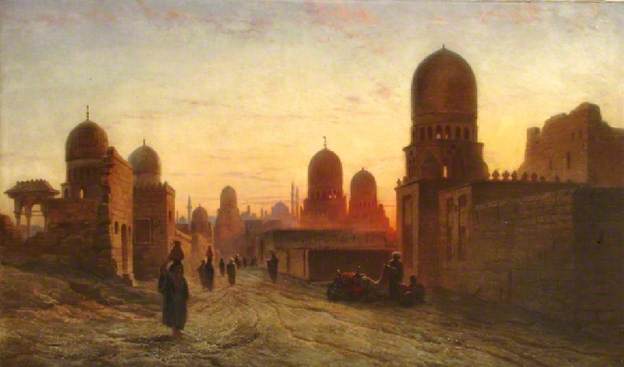
File:Louis Comfort Tiffany - On the Way between Old and New Cairo, Citadel Mosque of Mohammed Ali, and Tombs of the Mamelukes - Google Art Project.jpg

It’s a phantasmagoria of incredible vividness…two camels carrying flax brush the lantern hanging from a stall and catch fire. The terrified animals stampede with their flaming cargo and trample people underfoot, crashing through the markets, spreading death and destruction. A report from Gaza tells of an enormous sea creature washed ashore; the sultan writes to the governor asking him ‘to send this fish to Cairo, if it’s feasible.’ A dervish is hung. A Turk escapes in a borrowed uniform. Terrible tortures are inflicted on Badr al-din ibn Muzhir. The sultan’s performance at polo is judged mediocre. The Portuguese interrupt Muslim shipping and cause a shortage of turban material. A man has a dream that a huge treasure is buried under the pillars supporting a mosque, but he is unable to say exactly which one; the sultan orders the demolition of all the pillars; a huge crowd gathers to watch but the sultan then changes his mind - the dreamer is thought unreliable. A one year old elephant from Zanzibar is processed through the streets – the whole city turns out to watch, no elephant has been seen in the city for forty years. There are bloody quarrels among the black slaves. At night an eerie light is seen, shaped like the sail of a ship – there is no explanation. It’s a world of colour, passion, magic and dreams!


And ‘in the first days of this month, one heard of the death of Aziza bint Sathi, one of the most famous singers in Egypt, the marvel of the age. Her diction and her voice were admirable and were worthy of the poetic language (of the words). No other singer afterwards could be compared with her. No other chanteuse enjoyed such an appreciation among the nobles and grand functionaries of the state. This woman, whose reputation has been immense throughout Egypt, was over eighty when she died.’

I wonder what she sounded like. I’d love to have heard her sing.

Saturday, 29 June 2013

Midsummer England

As You Like It. Photo by Keith Pattison

It’s the Glastonbury Festival this weekend but we went to a more cultural version of this midsummer celebration of tribal identity – the Royal Shakespeare Company’s production of As You Like It in Stratford-on-Avon. Every thing the RSC do is amazing, and this was quite quite wonderful. Drawing on Shakespeare’s deep affinity with the folk customs and seasonal rhythms of the forest of Arden – the area around Stratford – the RSC dreamed up a modernised, Glastonbury-like, recreation of the earth celebrations of pagan England – a world of horned men, primal dancing, cross-dressing and fertility rites, exquisite music by Laura Marling and the kind of audience connection that only fantastically well-done live theatre can provide. An energetic celebration of the spirit of midsummer.
Alex Waldmann as Orlando and Rosie Hilal as Audrey in As You Like It. Photo by Keith Pattison
Coming out into the dark, swans float asleep on the River Avon; the trees of Warwickshire are in full sail, like ships on an inland sea; a deer crosses the road as we drive home; the year is at its height. Here's the trailer and some of Laura Marling's music for the play.

Thursday, 20 June 2013

Monty's hat

British icons from the Second World War: Churchill with his cigar and his Victory sign, General Montgomery in his black beret. I read the story of the beret yesterday with the death of Jim Fraser, aged 92, a humble tank driver in the North Africa campaign. Jim drove the tank from which Monty liked to address the troops. Monty also liked to wear a broad-brimmed Australian hat. The problem was that the desert wind kept whipping the hat off; the tank had to stop so that the hat could be  retrieved.

This finally proved too much for Jim. He recalled in his memoirs: "I shoved my beret up into the turret, muttering: 'Tell him to wear this and we'll get there quicker.' The aide-de-camp handed the beret to Monty who tried it on and liked it." Immortality for the ordinary man!

James Fraser
Jim (in the goggles) with Monty in Jim's (first?) hat


 Jim Fraser
Jim, wounded three times,  a winner of the Military Cross, and a proud beret wearer to the end.

Saturday, 8 June 2013

Beneath the Cretan earth

I still find myself pondering, almost haunted by, a story I was told a few years ago on a trip to Crete. I was looking for signs of Crete’s Venetian past and had come to a village that had been overlaid by Venetian houses sometime in the sixteenth or seventeenth century. But in Crete the layers lie one on top of the other, the Ottoman on the Venetian, the Venetian on the Byzantine, far back through the Romans to the Dorians and the Minoans, sea people who came to the Great Island in boats. This village was typical – it was a site of great antiquity, of considerable interest to archaeologists

We stayed in a small hotel there, run by a local family; also staying were an English couple who were regular visitors and good friends of the owners. They related to us a curious tale, told to them by the owners.

Some while back, an English archaeologist and his family had come to live in the village; their children were the same age as those of the hotel owners, and they became very close friends.  The families spent a lot of time together; the Cretan children learned English from the visitors who would come most evenings to the hotel and pass time with them. The archaeologist was also deeply occupied studying the land and drawing plans of the ancient field systems.

One day the archaeologist was walking in some fields that belonged to the Cretan family, with, I think, all the children – certainly the Cretan children were with him. He spotted an interesting hole in the ground but nothing much was said about it.

That evening I think, or maybe the next, the details aren’t exactly clear, the English family didn’t appear at the hotel, which was extremely unusual. In due course the Cretans went round to the archaeologist’s house to see what had happened. They found no one there. Their Landrover had gone; the house had been emptied of possessions. The English family had vanished into thin air.

The children thought back to the hole in the field which had caught the archaeologist’s attention. They returned to look. It was obvious that it had been dug open. There was a pit inside which was empty. They never saw or heard from their good English friends again. Something had been found there that caused the archaeologist to scoop up his family and vanish. The Cretan hoteliers had since become very suspicious of visiting archaeologists and over-friendly foreigners… It almost has the quality of a ghost story.

Wednesday, 29 May 2013

Constantinople fell today - and new covers!

29 May 1453 - the fall of Constantinople. In Istanbul processions and re-enactments. For the Greeks the memory of a painful loss - not that they need anything else painful to think about just now.


My UK publisher, Faber, have just given me wonderful new covers for Constantinople and Empires of the Sea. Just to warn you - one or two people have seen these on Amazon and think, particularly with Constantinople, that they are new books...unfortunately I don't write that fast, but I do almost have a brand! Constantinople carries the double-headed eagle of the Palaiologi - the Byzantine dynasty whose last emperor, Constantine XI, died fighting bravely on the city walls this afternoon, 560 years ago. It seems long ago and yet fresh in the memory of the Greek and Turkish peoples.


Monday, 27 May 2013

The Portuguese empire

Further on the Portuguese, this wonderful, melancholic Youtube video, accompanied by an aching soundtrack from Madredeus, a contemporary music group, highlights the reach of their empire - from Macau to Morocco, the straits of Hormuz to the west coast of Africa, Goa to Brazil. Both a snapshot of the extent and durability of the Portuguese achievement, linked to a palpable sense of nostalgia for vanished glory that, I guess, haunts all empires that have had their day - the British Empire not excluded.