Thursday, 25 February 2016

An Istanbul bookshop


'So often, in the past as well,' Van Gogh wrote in a letter, 'a visit to a bookshop has cheered me up and reminded me that there are good things in the world.'

Whenever I travel I like to go into bookshops, even if I can't understand the language. One bookshop I always visit when I'm in Istanbul - or actually two on opposite sides of the popular road between Sultanahmet and the Grand Bazaar in the middle of the historic city - are the English language bookshops of Galeri Kayseri.


Book shop Istanbul, Turkey


They have an unbeatable collection of book on Turkey in English - art books, history books, novels - everything from ancient Turkey to modern times, the Byzantines to the Ottomans, from Orhan Pamuk to...well me! It also showcases a lot of English language publishing on history and art produced in Turkey itself, books you can't find anywhere else. They're simply the best bookshops on Turkey in the world for English language readers.

I always drop in to see what's new and to talk with the two brothers who run the shops, Selahattin and Şener Tüysüz, about books and the history and architecture of Istanbul, on which they're immensely knowledgeable.


Selahattin in the main shop

Whereas everyone else in Istanbul is trying to sell me carpets, Selahattin and Şener sell me ideas for new books that I should write. Just now - or rather for my last couple of visits - they've been urging me to write a book about Suleiman the Magnificent, the greatest of sultans in the Ottoman golden age. It's a fantastically rich period of history. Or historical thrillers. I might just be tempted, one way or another!

 I'd always recommend a visit to Istanbul - and a trip to Galeri Kayseri in the process.


Saturday, 30 January 2016

How did Shakespeare speak?


I've always been fascinated by how Shakespeare's plays must have actually sounded. You get a hint sometimes from the baffling false rhymes - 'love' with 'prove' for example - so it's fascinating to hear one of his sonnets reconstructed by the famous British authority on language and linguistic history, David Crystal. To my ears a mixture of West Country and Midlands, with an earthy depth to it:

http://www.bbc.co.uk/programmes/p03gngpk


Thursday, 31 December 2015

A day out in the past

We went to Canterbury for Christmas. On Boxing Day – 26th December – we had our traditional outing to explore a local historic town. This year it was Faversham, on the north Kent coast, lying up a creek and surrounded by marshes. Faversham was once an important port, ferrying goods to and fro up the Thames in sailing barges, and lying on the coach road between London and Dover. And it’s a place of great visual fascination. Once a sailor’s town, a wharf, a shipbuilding centre and an early industrial place of gunpowder manufacture, it has a medieval hub of some grandeur, and many pubs. Somewhat down at heel now it retains immense charm and interest - streets of half-timbered houses and overhanging roofs, stucco facades, narrow passage ways and curious shop signs.


The medieval market hall


An array of pubs, operational and defunct - witness to a town of seamen:


Yellow brick:


And black and white timber. This house was the scene of one of the most notorious murders of the sixteenth century:
Recent textual analysis reveals that Shakespeare had a hand in writing 'Arden of Feversham'. We know that during the summer of 1596 the theatres of London were closed because of plague, and Shakespeare and his fellow actors of the company of The Chamberlain's Men took their plays on tour. They acted in Faversham. Did they treat the locals to a version of events on their doorstep?

We also saw...

Glimpses down alleyways:


Festive front doors:


A Thames sailing barge:


A rare medieval painted pillar in the church:


And a pack of beagles:


Happy Christmas...!

Monday, 21 December 2015

Lykia

I made a special trip to the British Museum recently to look at the Lykian monuments from ancient Xanthos. Lykia (or Lycia) was a civilization on the coasts and upland heights of south western Turkey, influenced by both the Persians and the Greeks that reached its height in the sixth and fifth centuries BC.  Lykian tombs still dot the landscape, large blocks like immense loaves, and Xanthos itself is hugely impressive.

Lykian tombs collapse into the sea at Aperlae - a very old slide!


Conquered by Alexander the Great, the civilization and cities  of Lykia were unknown in the West – and were only rediscovered in the 1830s by the British archaeologist and traveller Charles Fellows. Fellows made several expeditions to this remote area, mapped the sites quite carefully and with the permission of the Ottoman authorities and the help of the sailors of a Royal Navy ship, he excavated and removed some of the friezes and remarkable temple-like tombs, which now remain some of the BM’s most impressive exhibits. They include expressive friezes of horses, men, bulls and winged harpies, a complete colonnaded temple – the Nereid monument – immensely popular with visitors for photo opportunities, and some of the  tombs with their massive curved stone lids.


The Nereid monument


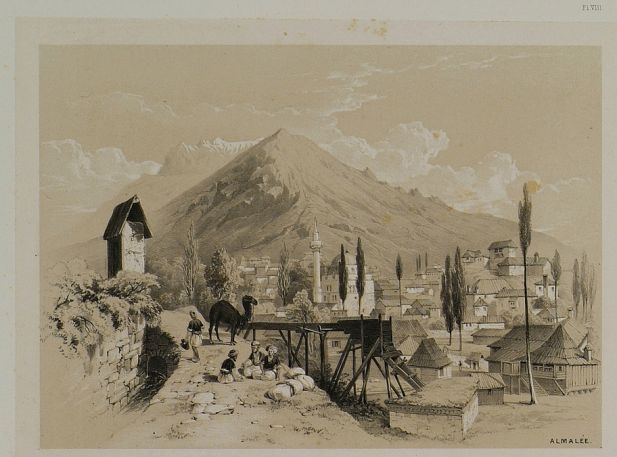
It was not only the exhibits that fascinated me. It was also Fellows’ written accounts, which I had been reading, of his journeys across western Turkey, accompanied by a dragoman – an interpreter – and an artist called George Scharf, who not only drew pictures of the tombs in situ, but produced vivid vignettes of rural Turkish life, its people, costumes and buildings. I made some of the same journeys on foot in the 1970s and spent time on the Lykian Coast. What struck me about Scharf’s pictures was that, apart from the dress and the disappearance of the fez, much that they saw in the 1840s was still in place in the 1970s, though by then it was on the point of vanishing
I was just getting stuck into a good look at Fellows’ collection at the BM when the fire alarm went off and we all had to shuffle out.

Scharf's drawing of the tower tombs at Xanthos.


And one in the the BM - the protruding stone 'joists' suggest that these tombs imitated timber structures


Tombs catching the last light of day near Kekova


Monday, 7 December 2015

Thursday, 26 November 2015

Mapping the Great Siege of Malta


The Great Siege of 1565 has been much in mind lately, having been to a conference on it recently. Amongst other things the siege produced a huge number of illustrated maps - news sheet produced in Italy and beyond day after day updating the progress of the contest - almost the earliest forms of printed war reportage. Whilst thinking about this my friend Allan Langdale sent me some pictures of Malta siege maps from the painted gallery of maps in the Vatican - they're beautiful renderings of the event. Allan runs a great photographic blog on travel, art and architecture at:

 https://allansartworlds.sites.ucsc.edu/

Thanks, Allan!

The Ottoman fleet in harbour on the left, and their troops attacking the isolated fort of St Elmo on the tip of the peninsula that is now Valletta (inset bottom left). The other two fortifications of the Knights of Malta are under siege on the right.


Here's a close up

And the gallery also has a wonderful birds-eye view of the clashing of the Christian and Ottoman fleets at the battle of Lepanto in 1571:


Friday, 13 November 2015

A walk along the Maltese coast

I’m in Malta at the moment for a conference on the 450th anniversary of the Great Siege – courtesy of the Malta Historical Society and the University of Malta. Today I took a morning out, before the next session, to walk along the east coast, north of St Julian’s Bay.


The weather is lovely; warm autumn sun, the sea a piercing blue, light wind – the craggy limestone garrigue slopes down to the water, then drops sheer into the enticing depths. The coastal plain is a spiky stone terrace, thin red soil and tenacious Mediterranean plants.  Along the headland, the watch towers of the Knights of Malta, white stone cubes, dotted from headland to headland – to signal the approach of Ottoman fleets or Barbary pirates:


Nearby one tower, there’s a conical stone chamber chiselled out of the rock at a forward facing angle. I’d never seen one of these before. It’s a primitive stone mortar – a fougasse - designed by the Knights to fire stone shot over the sea to slow down a landing by pirates:


There are rock cut salt pans, now abandoned, and small bays where retired Maltese people swim and watch the day go by. I jump in too - a clean splash into the tranquillizing blue.  Further along the coast I come across a curious scene from a hundred years ago - white tents by the sea with the red cross symbol, nurses in period uniforms, horse drawn carts and first world war soldiers. It's a film set for a drama documentary.


On the headland of the next watchtower, Qalet Marku, I too sit down and let time slip. The sea is bands of blue, ruffled dark in places, then a lighter shade that almost hurts the eyes, a kind of marine steel. The suck and slosh of the water is soothing; the light wind and the sun coming and going behind clouds; red earth; white snail shells; dried out spikes of flowers; the evidence of ancient geology in fossilized rocks; in the distance the cliffs of Gozo. The light is so good you can pick out miniscule details. A red pickup truck parks nearby and a family of Muslims climb out - the women, headscarfed and robed in bright colours. One a brilliant red against the sea. They set down a carpet on the ground, and a hookah. A baby is changed. A pan of aubergines appear. They sit round in a circle and eat. Nomads in a landscape.

I amble home along the coast; time slips by to the sound of the sea. A warship appears beyond the headland - the EU/African summit on migration has just taken place - men in dark suits talking on phones in plate glassed hotels, cavalcades of black limousines with flashing lights and motorcycle outriders disrupting the traffic. Merkel, Hollande, Cameron amongst others, with African heads of state, trying to tackle the problems of human migration across the sea of migrations. But out here it seems briefly a long way off.

"The sea that is always counting"