Sunday, 13 January 2013

'To the right honourable the governor of this city'

One of the things that especially attracts me to history is reading first hand accounts – to hear people from the past speaking to us in their own voices. Yesterday, whilst our local history group was going through some archive material, we found a typescript of a record from the English civil war, fought between Parliament and the King Charles I. This is the petition from a soldier, John Barret, for aid from Edward Massie, the governor of Gloucester (a Parliamentary city), after the Parliamentary forces were put to flight by royalists  at the town of Painswick a few miles away, in March 1644.

The petition of John Barret, corporal in Captain Cotton his company, humbly sheweth:

Your petitioner was lately commanded out in the party went…in Painswick; and being put to flight, I was in the pursuit…taken by two of the enemy’s horse and six of their foot, of whom I was [knocked] down and left for dead; and having received ten wounds of them, [they] stripped me stark naked to the very skin; and ever since that time I have lain bedrid under the chyrurgion’s hands, and now, being able to rise, I cannot for want of clothes: therefore I beseech your honour that you would be pleased to take order that I may have some clothes (both linen and woollen) speedily that I may not perish for want thereof.

Your petitioner is in great want of firing, having received but two green willow blocks (that two men might carry) of the quarter-master since I was wounded.

Your petitioner received 7 wounds in the head, 5 of them through the skull, 1 cut in the back (to the bone) with a pole axe, his elbow cut off bone and all, his hand slit between the fingers, as Mr Paradine the chyrugion affirmeth, who hath almost cured them all, and very carefully and willingly he hath taken the pains to do it; how to satisfy him we know not; he was never the man that asked us a farthing.

And your petitioner shall pray…’

This hair-raising tale of terrible wounds and miraculous survival evidently had its effect, as the record goes on to record the governor’s response:

‘Captain Blaney,
I desire you to pay this petitioner 20s. to buy him clothes.

Edward Massie’

Twenty shillings – a pound – sounds like a tidy sum in the seventeenth century and there are lots of questions one might ask about this as a piece of evidence. Barret’s wounds sound so severe that his survival appears almost miraculous. Who took the trouble to rescue him from the battlefield? And did he exaggerate the extent of his injuries for maximum effect? At any rate it’s a wonderfully vivid account – and an authentic voice speaking to us across the centuries.

Monday, 7 January 2013

Stealing a theatre

Over Christmas I read 1599 by James Shapiro, a forensic study of one pivotal year in the life of William Shakespeare. I felt I was starting to read it in real time, as the book opens in London at Christmas time – on 28th December 1598, to be exact. It was a cold, snow-swept day. A group of armed men – carrying swords, daggers and hatchets – were walking with stealthy purpose through the muffled London streets. They were a troupe of actors, the Chamberlain’s Men, and the authentic weapons were the props from their bloodthirsty revenge tragedies, but they were being carried with serious intent. Amongst their number was almost certainly Shakespeare himself.

The Chamberlain’s Men were in deep trouble. They owned a wooden theatre – known, rather prosaically as the Theatre in Shoreditch, which they had been banned by the authorities from occupying. The ground on which it stood was leased from a landlord, Giles Allen, with whom they had fallen out. Without a theatre to play in their future was bleak – and there was a certainty that Allen would now claim the building's valuable timber for himself – but he was temporarily out of London for Christmas. Spotting a window of opportunity the actors decided to grab the theatre back, dismantle it and carry it away, whilst Allen was off the scene. They were armed to repulse any attempt to stop them. For Shakespeare, one of the shareholders in the company, this was a critical moment. The dawn raid had been undertaken in strict secrecy.

In a thick snow storm, and under the instruction of Peter Street, a master carpenter, they repelled all attempts to prevent them. By night fall, the enormous timbers of the frame, each a foot square and weighing half a ton, had been loaded onto wagons and wheeled away to a warehouse on the Thames. Allen returned to find an empty lot – and failed to regain the structure in a subsequent court battle.

The following spring, the Theatre was re-erected on the South Bank at Southwark, outside the jurisdiction of the City of London, and re-christened the Globe. And Shakespeare was writing furiously – new plays, new ways of seeing the world. 1599 saw Henry the Fifth, Julius Caesar, As You Like It and Hamlet all brought to the light of day there, in a tumultuous year for England, London and the future of theatre.


"Or may we cram within this wooden O the very casques that did affright the air at Agincourt?"
Henry the Fifth

Tuesday, 1 January 2013

Happy New Year

A dynamic approach to 2013. Thanks to Sidney, Hector and their human servants...

Sunday, 30 December 2012

White cliffs

Notes from the 24th December. We’re in Kent for Christmas and today is the now almost traditional Christmas Eve walk – this year on the White Cliffs above Dover harbour. It’s a fantastically dull, dirty winter afternoon, the wind so strong on the cliffs you can lean into it; out in the channel, a green sea kicked into white horses by the violent gusts; somewhere out there in the mizzle lies the coast of France, now blotted out by low cloud. The ferries stand off from the breakwater waiting their turn to go in.

The white cliffs have a special meaning in the history of this island: a defence, a frontier, a place of departure and return, a relief to be waving farewell to or a focus for homesickness – an icon of some kind of England.

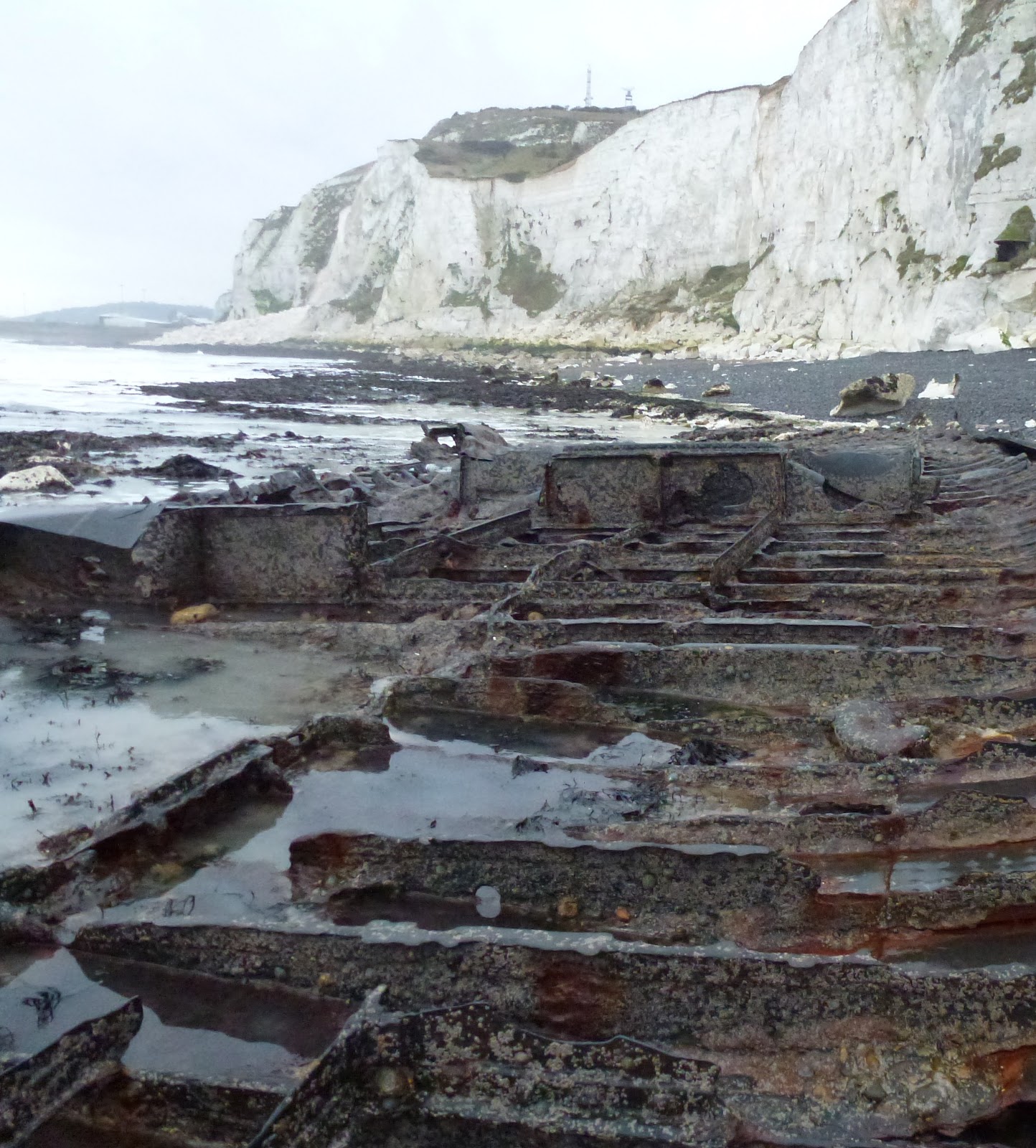
I’ve walked these cliffs many times over the past thirty years but today the tide is low and as we look down from the cliffs I get to witness something I’ve never heard about before. Far below, beached on the black rocks ,the outline of a wrecked ship, like the fossil remains of some giant prehistoric fish.


We scramble down the coastal path to investigate. There’s a narrow walk way above the beach to a row of Second World War searchlight stations, suspended on the cliff face like outsized swallows nests guarding the approaches of Dover harbour. It’s at sites like this that the British people were to be rallied by Churchill to fight on the beaches. Inside, a sequence of eerie concrete chambers from which we squint into the wind through the tattered remains of their steel shutters, which have been eroded into beautiful abstract patterns. There’s a weird, hair-raising attraction to Second World War archaeology. 
  

Down on the beach, it’s possible to climb onto the remnant of the ship, whose iron ribs have become fused with the rocks, and to stand on the last remaining piece of superstructure, like the conning tower of a lost submarine surfacing from the depths for a brief hour. There’s something incredibly awe-inspiring about this beached, ruined structure, turned into a network of iron rock pools reflecting the twilight sky, with the black shingle beach and the white cliffs shining in the gloom and the wind whipping up the midwinter sea.


These are the durable remains of the SS Falcon. Carrying a volatile cargo of hemp and matches to Dover in 1926, it caught fire and was beached in the bay outside the harbour. Amazingly there’s film footage of the ship on fire and the crew’s rescue by the Dover lifeboat.

Friday, 21 December 2012

The wettest place on earth

The days before Christmas in the English countryside have been dreary with continuous rain and low cloud, so that twilight seems to fall at about two in the afternoon. It has a charm all of its own - the point when the year shrinks back to its source and there is nothing more pleasurable than to draw the curtains as night falls, turn up the heating and settle to a book. The book, in my case, has been Chasing the Monsoon by Alexander Frater, a traveller's account of tracking the monsoon day by day across the Indian subcontinent as it travels north. It's a time of anxiety and rejoicing - anxiety that the monsoon might fail or be insufficient - rejoicing that when it does come, in full force, it ends the insufferably hot months, stirs new smells from the dust and fertility from the earth.

Frater followed the monsoon in all its manifestations and his quest ended in the town of Cherrapunji in the far east of India, which receives its rain from the Bay of Bengal, and lays claim to being the wettest place on earth. This was perhaps the most mournful posting in the British Raj - unless you were a keen botanist with an interest in mosses, ferns and orchids - which many medical men and colonial administrators were.

In 1850 a doctor called Joseph Hooker spent the monsoon months in the town. He called it 'as bleak and inhospitable as can be imagined' - its climate certainly got to the British. (Frater visited the mournful British graveyard and spotted a number of tombstones with the words 'Died by His Own Hand’.) Hooker was astonished by the absolute and continuous deluge that bombarded the town during the months of his visit. He noted the recordings of a previous resident, Mr Yule:

" who stated that in the month of August, 1841, 264 inches of rain fell, or twenty-two feet...Dr Thompson and I also recorded thirty inches in one day and night, and during the seven months of our stay, upwards of 500 inches fell, so that the total annual fall perhaps greatly exceeded [the] 600 inches, or fifty feet, which had been registered in succeeding years."

Somehow a few wet English days in December seem quite light in comparison! Happy Christmas and New Year.


Saturday, 15 December 2012

The giant carrots of Beypazarı

The wonders of Turkey…When I was in Istanbul in October I was introduced to a mention of the carrot town of Beypazarı in central Turkey, by Mary Isin who is an authority on Turkish heritage vegetables.

Beypazarı is the carrot capital of Turkey – probably the carrot capital of the world. Over half the country’s carrots are grown in the area. They hold an annual carrot and stew festival here and have many and ingenious culinary uses for carrots, including carrot ice-cream and carrot-flavoured Turkish delight.

Here’s a roundabout in the town proudly sporting Beypazarı’s iconic vegetable:


Nowadays the farmers tend to grow Dutch carrots, but what caught my attention were rumours of the almost extinct giant carrot – the historical mega-carrot – once grown in the area. Mary went to investigate and to acquire some seeds – and sent me this picture of the mighty vegetable. These are, apparently, quite average specimens – they can grow to over a metre in length…


Mary is also a historian of Turkish and Ottoman food who has just written the definitive book on the history of Turkey's love of puddings: Sherbet and spice : the Complete Story of Turkish Sweets and Desserts – part recipe book, part cultural history of a deep tradition that could produce, and I quote, ‘One hundred sculpted sugar lions, baklava the size of cartwheels a thousand layers thick, halva made in memory of the dead, rose jam in a hundred pots of Dresden china, violet sherbet for the sultan and parrots addicted to sugar…the stories behind Turkey's huge variety of sweets and puddings, valued not only for their taste but as symbols of happiness, good fortune and goodwill, are as fascinating as their flavour.’ Cultural and gastronomic history from the land of the giant carrot!

On the cover, the float of the guild of sugar merchants is being pulled along in one of the flamboyant Ottoman processions in Istanbul, sugar piled high on the shelves, and in the cage the sugar-loving parrot which, Mary tells me, was the guild's symbol.

Saturday, 8 December 2012

How to catch a leopard


Looking back through some photographs I took in Lisbon during the spring I was charmed and delighted to remember my visit to the National Museum of Azulejos. Azulejos – from the Arabic for ‘small stones’ – are the decorative tiles that are a distinctive feature of Portuguese art and architecture, visible everywhere - in churches, on the facades of buildings, cafes and public spaces – a rich tradition that stretches back to Moorish times. You find ceramic pictures everywhere in Portugal. They can be pious, historical, abstract, surreal - or just funny. This simple icon protected an alleyway in the old quarter of Alfama (above right), whilst a shop was adorned by an inquisitive monkey:
Historical personages were popular in the National Museum. Here's Catherine of Braganza, married to King Charles II of England (looking rather saucy), a curious armless Napoleon,


and, a more modern take, a version of a famous sketch of Portugal's great poet, Fernando Pessoa, beadily reading the paper:


A seventeenth century fantasy depiction of a leopard hunt particularly caught my fancy - animals and themes from Portugal's colonial adventures seem to have provided rich subject matter for the tile artists. The hunters set out in pursuit of some rather portly leopards, who look as though they've spent too long eating pastries in Lisbon's cafes. The hunters are armed with nets and traps to snare their prey:


But their most cunning device is the mirror trap. The leopard approaches the trap, sees a rival leopard in the mirror, and presumably maddened with rage, springs into the trap to attack - the lid is snapped shut and the leopard is taken!